
Southern Indiana · The home front
When Charlestown became a wartime boomtown.
The ammunition plant’s story begins outside the factory gates—with farms, rented rooms, family moves and a town trying to keep up.
Why this story matters
The town was part of the war effort.
Factory histories follow what was made. Family histories can show what it took to make a life around the work: a place to sleep, a trip to school, a daily commute and a new circle of neighbors.
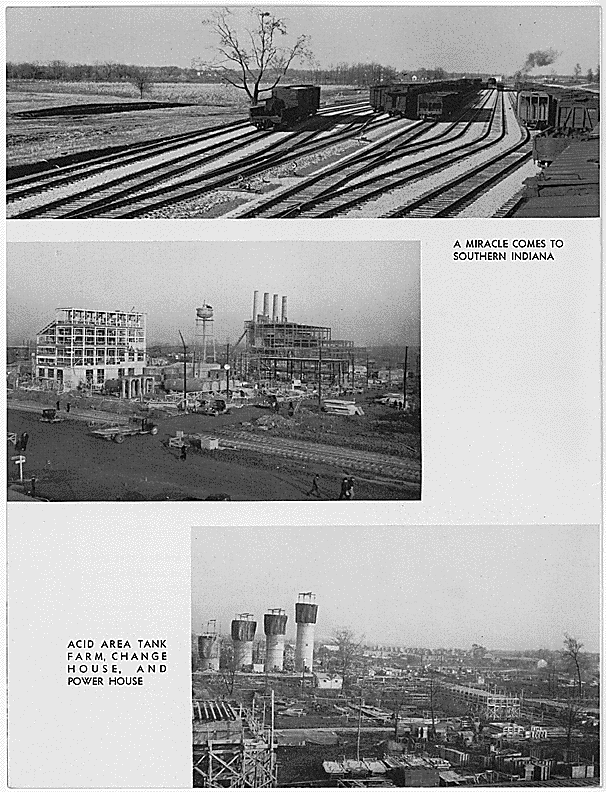
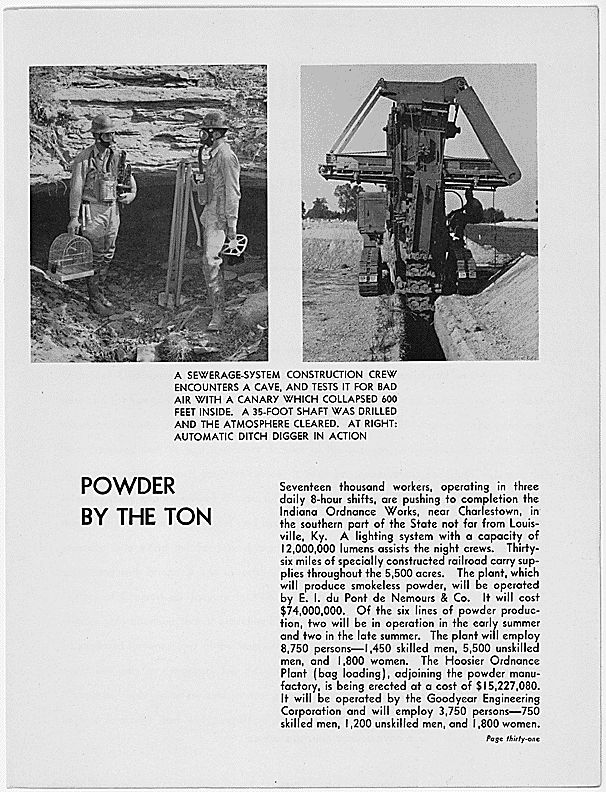
The original booklet identifies Indiana Ordnance Works near Charlestown. Its text describes construction in progress and planned operations; those forecasts should not be read as proof of what was ultimately completed.
First came the land.
The Indiana Historical Bureau’s research describes a community of 939 people selected for its labor supply, inexpensive land, rail connections and access to Ohio River water. DuPont’s agents purchased farms, homes, churches and businesses for the new industrial complex. [1]
A property transaction is also a possible family story. Where did the household go? Which belongings or photographs came with it? Did relatives stay nearby? Those are research questions for this file, rather than details we can assume about every displaced household.
Then came the workers.
The state marker records an influx of more than 27,000 workers and pressures on housing, traffic and sanitation. That figure describes the arriving workforce; it is not a census showing 27,000 new permanent town residents. [2]
Indiana DNR’s teaching material puts the wider change in perspective: Clark County gained about 17,000 people between 1940 and 1950, and Charlestown’s population tripled during 1940–1941. [3] County population, town population and plant employment measure different things.
To recover the daily experience, we need details smaller than a production total. A street name can locate worker housing. A school photograph can identify children who arrived with their parents. An employee’s caption can give an approximate year and a department.
The people behind the familiar name.
The state marker identifies women and African Americans among the workforce and also records German prisoners of war at the complex. [2] Those experiences should be researched on their own terms, with dates and evidence attached.
Do you have a relative’s story? Tell us who shared it and how they knew the place. “My father told me” and “I remember” are both useful beginnings, provided we keep the distinction visible. A personal memory may identify a new lead without settling the entire historical record.
Start with one small piece.
- A person: their name, job if known and approximate years.
- A photograph: both sides, its caption and who owns it.
- A place: a housing address, school, shop or familiar route.
- A record: a deed, newsletter, letter or link to an archive.
Use material you own or have permission to share. Remove private addresses, account details and other sensitive information from personal records before submitting.
Continue into the ammunition-plant place story → It brings the questions, sources and member discussion together.
Read the record
Sources and limits
- Indiana Historical Bureau: World War II Comes to Indiana, Part I — Research on land acquisition, plant construction and the arriving workforce.
- Indiana Historical Bureau: WWII Army Ammunition Plant — Marker text with annotated research, historical names and later production periods.
- Indiana DNR: Conflict, War and Parks — Teaching material on the plant and regional population change.
- National Archives: Arsenals of Democracy, NAID 306712 — original War Department construction photographs. The March 1941 government publications catalog records the booklet’s publication. The collection-level 1992 date imported into Commons is not the year of these construction scenes.
Research checked October 2, 2026. Population figures retain their different dates and definitions. The family-history questions on this page are invitations to contribute, not invented accounts from named workers.