
Lost America · Archival film
What did everyday American life look like in 1915?
The camera caught schoolchildren, city crowds, markets, ice workers and rural mail carriers. The original records reveal something just as important: when and where each scene was actually filmed.
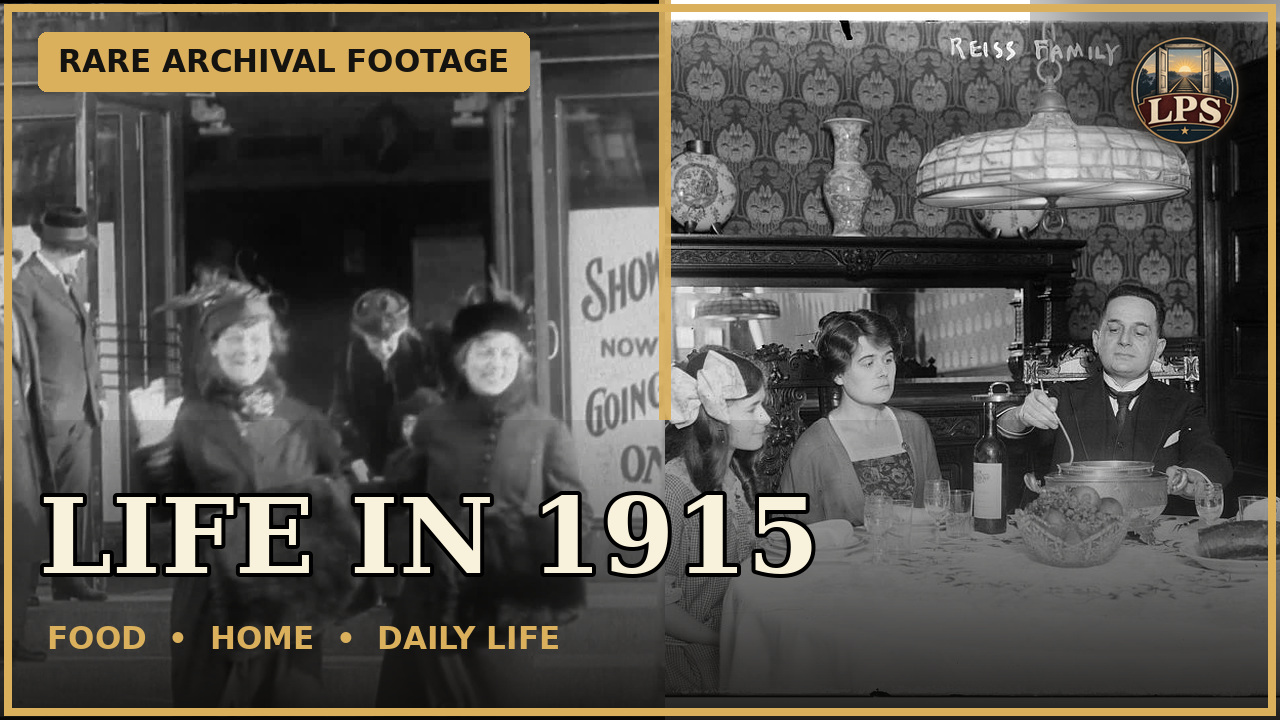
Read the dates first
This is a window—not a complete portrait.
The film uses 1915 as its central lens, but the surviving scenes were recorded from 1902 through about 1915. Together they show fragments of real life in the early twentieth century. They do not represent every region, household or American experience.
Watch the complete film
Look closely at the ordinary moments.
Watch for the details people rarely posed for: how a crowd moves, what work requires, what children notice and how public life fills the frame.
The first rule is to keep the dates attached
“American life in 1915” is an invitation to enter a period, not a claim that every frame came from one calendar year. The Claremont Theatre film is dated 1915. The school-day scene is cataloged as probably 1914. The fish market, rural mail and ice-work films come from 1902 and 1903. Keeping those dates visible makes the film more useful, not less.
Movement, clothing, tools, streets, work routines, public spaces and unguarded expressions.
Most private life, sound, context outside the frame and the experiences of people the camera did not reach.
New York moved at street level
The Claremont Theatre and fish-market films put the viewer inside a busy public world. People share the frame with carts, storefronts, goods and one another. The footage does not explain what each person was thinking, but it records the pace and density of ordinary city life in a way a posed photograph cannot.
Work was visible in the landscape
Cutting and channeling ice turned winter weather into stored summer refrigeration. Rural mail delivery connected households far from a city street. These scenes show tools and systems at work, but they also remind us that convenience depended on somebody else’s time, strength and risk.
The faces are evidence too
Schoolchildren leaving for the day and adults crossing a street do not know what later viewers will search for in their expressions. That is precisely why the footage matters. A glance toward the camera, a cluster of friends or the way someone carries a bundle can turn an abstract year into a human moment.
No reel can stand for a whole country
The surviving films are selective. Camera operators chose where to stand, institutions chose what to preserve and catalogers later supplied titles and dates. The result is valuable evidence, but it cannot speak for every race, region, class, household or private experience. The honest way to watch is to notice what appears—and ask who and what remain outside the frame.
Open the original records